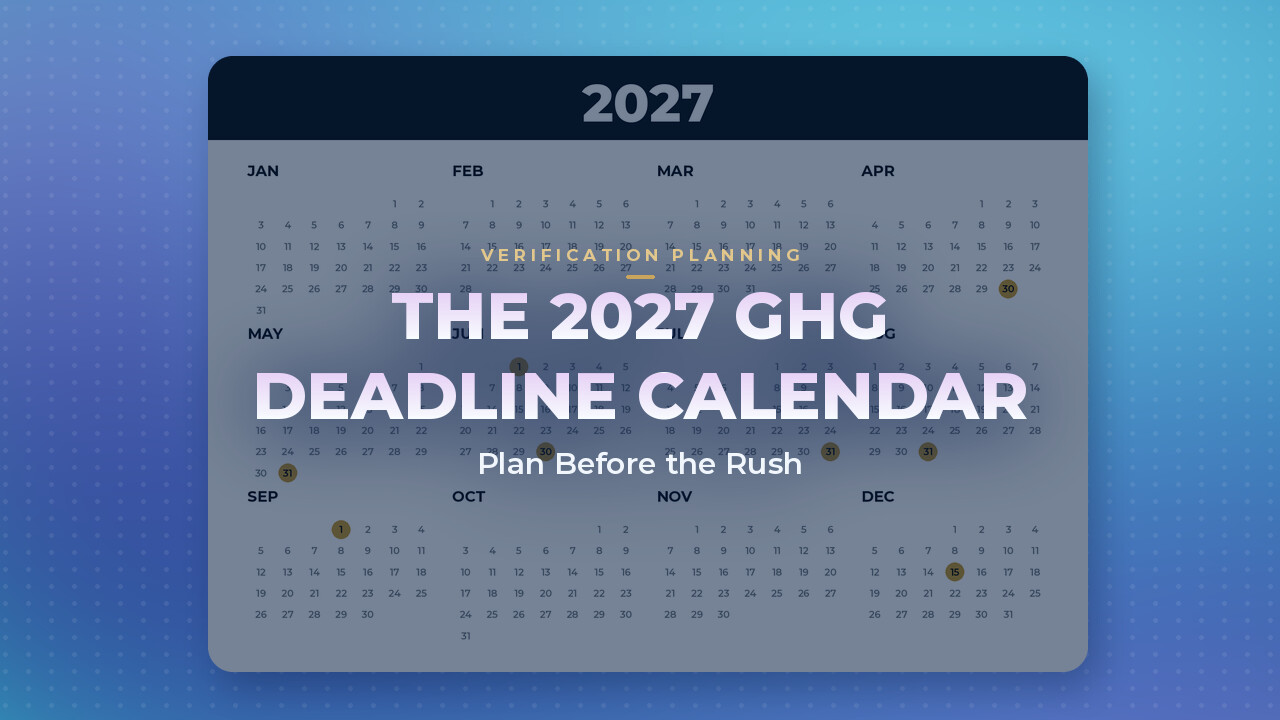
The 2027 GHG Verification Deadline Calendar: Plan Before the Rush
Every spring, compliance teams across Canada and the United States find themselves scrambling to line up verifiers for deadlines that were visible on the calendar for months. Verification bodies have finite capacity, and the programs with the highest demand all share overlapping timelines. Getting your verification arrangements in place now, before the new year, is the simplest way to avoid that problem.
This is a program-by-program breakdown of the major verification deadlines coming in 2027, along with what each one requires and what tends to go wrong when planning starts too late.
2027 at a Glance
| Date | Program | What is due |
|---|---|---|
| March 31 | CFR | Q4 2026 quarterly credit creation report |
| April 30 | CFR | Annual credit creation report and material balance report, with verification reports |
| May 31 | BC GGIRCA | Verified annual emissions report |
| June 1 | Federal OBPS | Annual report with verification report |
| June 1 | Ontario EPS | GHG report |
| June 30 | Alberta TIER | Verified compliance report |
| June 30 | CFR | Credit adjustment report, with verification report |
| July 31 | CFR | Compliance report, with verification report |
| August 31 | CARB LCFS | Verification statements for 2026 data, including EV charging for the first time |
| September 1 | Ontario EPS | Verification report and statement |
| December 15 | CFR | Complementary compliance report, if required |
Canada’s Clean Fuel Regulations (CFR)
The CFR runs on multiple overlapping deadlines depending on your credit category and report type. Credits for supplying low-carbon-intensity fuels, such as ethanol, biodiesel, renewable diesel and renewable natural gas, are reported quarterly as well as annually. The quarterly reports are not verified on their own, but the data in them feeds the annual report that is, so verification readiness is a year-round activity rather than a single annual event.
| Report type | Deadline | Verified? |
|---|---|---|
| Credit creation (quarterly, Q4 2026) | March 31 | No |
| Annual credit creation report (all categories) | April 30 | Yes |
| Material balance report | April 30 | Yes |
| Credit creation (quarterly, Q1) | June 30 | No |
| Credit adjustment report | June 30 | Yes |
| Compliance report | July 31 | Yes |
| Credit creation (quarterly, Q2) | September 30 | No |
| Complementary compliance report (if required) | December 15 | Yes |
| Credit creation (quarterly, Q3) | December 31 | No |
The April 30 deadline for annual credit creation reports is the one that catches organizations off guard most often. It falls early in the year when internal teams are still working through Q4 data, and verifier availability at that time of year is limited. Engaging your verifier in Q4 of the prior year is the most reliable way to protect that deadline.
The five-year consecutive engagement limit also applies under the CFR. Individual verifiers are capped at five years on the same reporting entity before a mandatory three-year break. If your current verifier is approaching that limit, you need a new one in place before the next compliance period opens.
Federal Output-Based Pricing System (OBPS)
The OBPS annual emissions verification deadline is June 1. For facilities covered under the federal system, the annual report covering the prior compliance year must be independently verified and submitted to Environment and Climate Change Canada by that date.
The OBPS has a six-year consecutive verification limit per facility, after which the same verification body must take a three-year break before resuming. If your facility is approaching that threshold, it is worth confirming now rather than discovering it mid-engagement.
Verification under the OBPS covers all reported emission sources including stationary combustion, process emissions, and fugitive sources alongside production output data, which means the data review is thorough and the timeline from engagement to completed verification statement is longer than many facilities expect. Starting the engagement in January or February for a June 1 deadline is not early. It is about right.
Alberta TIER
The Alberta TIER compliance report verification deadline is June 30. Facilities emitting above 100,000 tonnes of CO2e per year and opted-in facilities must have their annual compliance reports independently verified before submission.
TIER has specific training requirements that not every verification body meets. Lead Verifiers, Peer Reviewers, and Designated Signing Authorities must all complete Alberta’s mandatory TIER verification training before they can sign off on a report. When selecting a verifier for TIER, confirming that training is current is not optional.
The program also caps consecutive verifications at five for the same facility before a two-cycle break applies. Benchmark application verifications and offset project verifications under the Alberta Emission Offset Registry follow their own submission timelines tied to the compliance calendar.
Ontario Emissions Performance Standards (EPS)
Ontario EPS has a split deadline structure. GHG reports are due June 1, and verification statements follow on September 1. That gap between the report and the verification statement gives facilities more time than some other programs, but it does not mean verification planning can wait until summer.
Ontario EPS does not have a fixed consecutive-year rotation cap. Instead, the verification body must complete a Compromised Impartiality Assessment before every engagement and file a mitigation plan with the Ministry of Environment if a conflict is identified. The practical implication is that your verifier relationship needs to be reviewed and documented at the start of each cycle, not assumed to carry over automatically.
BC GGIRCA
BC OBPS-regulated facilities must submit verified annual emissions reports by May 31. That is the earliest of the facility emissions deadlines covered here, and it tends to catch facilities off guard because planning for it needs to start before the end of the prior year.
For facilities generating provincial offset credits under BC’s approved protocols, including improved forest management projects under the Forest Carbon Offset Protocol, verification timelines are tied to each project’s reporting period rather than a fixed annual date. If you are running an IFM project and have not confirmed your verification arrangements for the current reporting cycle, that conversation should happen now.
CARB Low Carbon Fuel Standard (LCFS)
CARB LCFS verification statements for the 2026 data year are due August 31, 2027. That deadline covers annual fuel pathway reports and quarterly fuel transaction reports for the prior year, and applies to all fuel producers, importers, and aggregators with active pathways in the California market.
The LCFS requires verification by a CARB-approved verification body, not just any ISO-accredited verifier. There are relatively few approved bodies, and those operating across both U.S. and Canadian programs have particularly limited availability. For organizations with complex portfolios spanning multiple fuel types and reporting entities, the verification scope can be substantial and the timeline from engagement to completed statements needs to reflect that.
CARB also requires a five-year look-back on prior services when assessing verifier independence. If your verification body has provided other services to your organization, confirming their eligibility before the engagement begins saves time later.
EV charging credits under the LCFS become subject to third-party verification starting with the 2026 reporting year, with statements due August 31, 2027. If you operate EV charging infrastructure with a California nexus and have not engaged a CARB-approved verifier yet, this cycle is the first one where it is required.
The Practical Reality of Verifier Capacity
The spring window from March through June is the busiest period across all of these programs. OBPS, TIER, and BC GGIRCA deadlines all fall within that window, and CFR deadlines add to the load throughout the year. Verification bodies plan their capacity months in advance, and organizations that engage early get better availability, more responsive service, and fewer surprises.
If you are participating in more than one program, working with a verification body that holds the accreditations to cover your full scope means one engagement relationship rather than multiple. That matters practically when deadlines overlap and coordination between verifiers would otherwise be required.
How Standard Carbon Can Help
Standard Carbon is accredited by the Standards Council of Canada under ISO 14065:2020 and is an approved CARB LCFS verification body. We conduct verifications across CFR, OBPS, Alberta TIER, Ontario EPS, BC GGIRCA, and CARB LCFS, and work directly with clients to build verification timelines that fit their reporting cycles and internal planning calendars. See our full list of programs on our accreditation page.
If you are mapping out your 2027 verification schedule, get in touch now.
Need a verifier or a GHG inventory?
Put what you’ve read into practice with our accredited team.
Keep Reading
CNG and the Clean Fuel Regulations: How Compressed Natural Gas Credits Are Generated and Verified
EV Charging and the Clean Fuel Regulations: How Charging Networks Generate Carbon Credits