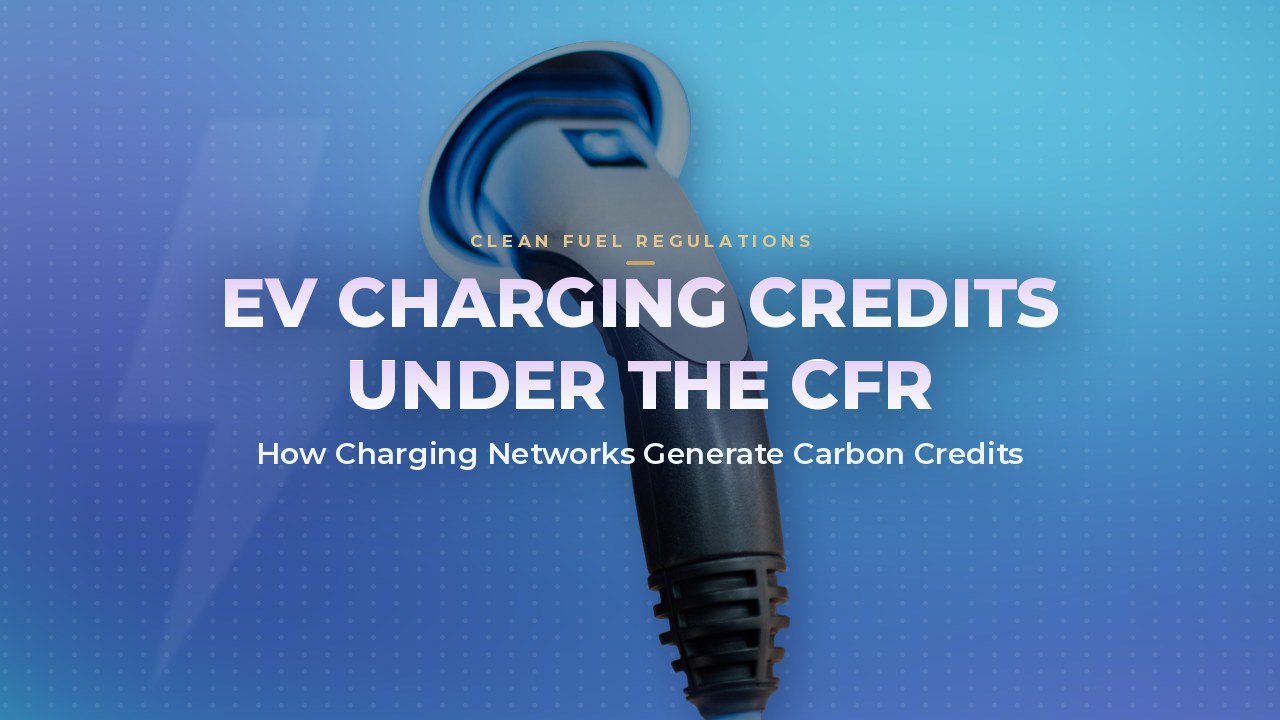
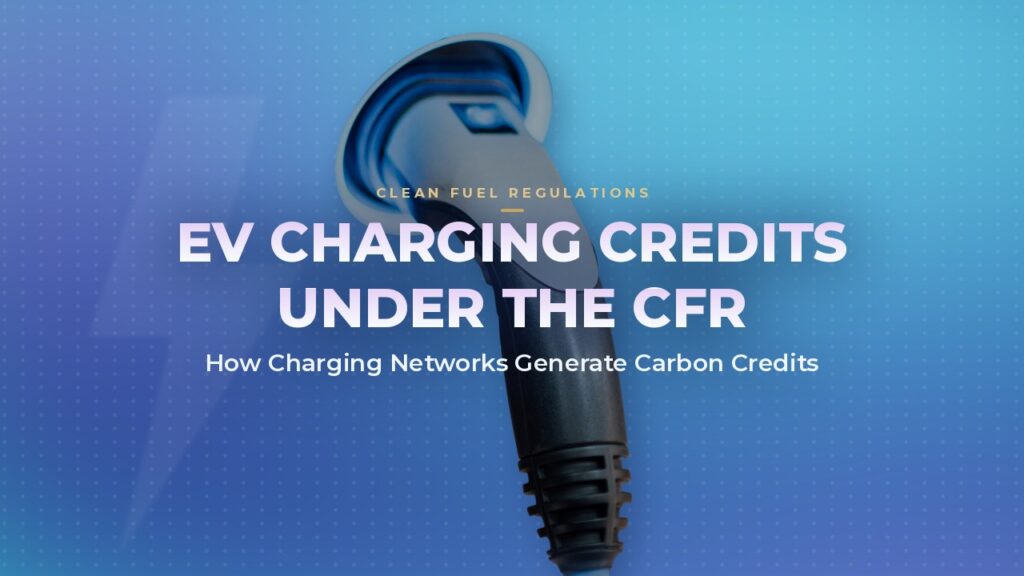
EV Charging and the Clean Fuel Regulations: How Charging Networks Generate Carbon Credits
If you operate an electric vehicle charging network in Canada, you may be sitting on a revenue stream you have not fully accounted for.
Under Canada’s Clean Fuel Regulations (CFR), EV charging can generate compliance credits worth real money in the credit market. But the annual report behind those credits needs to be independently verified by an accredited third-party verifier.
Here is how it works.
EV Charging as a Carbon Credit Generator
The CFR is built on a straightforward principle. Activities that displace higher-carbon fuels with lower-carbon alternatives generate credits. EV charging does exactly that. Every kilowatt-hour of electricity delivered to a vehicle through your charging network displaces gasoline or diesel that would otherwise have been burned.
Those displaced emissions translate into credits under compliance category 3 of the CFR. Each credit represents one tonne of CO2 equivalent avoided.
Compliance category 3 covers end-use fuel switching in transportation: supplying electricity, hydrogen, natural gas or propane to vehicles in place of gasoline or diesel. EV charging is one of its main activities. It recognizes that the transition to electric transportation requires investment in charging infrastructure, and it gives operators a financial incentive to build and operate that infrastructure.
Who Qualifies as a Category 3 Credit Generator?
Credits are created by a registered creator, which means registering with Environment and Climate Change Canada (ECCC) and meeting the eligibility requirements for EV charging credit creation.
Who is eligible depends on the type of charging. For public charging stations and home charging, it is the charging-network operator, the business that runs the platform collecting data on the electricity supplied. For other stations, such as fleet and workplace charging, it is the charging-site host that owns or leases the station.
Your charging network does not need to be massive to qualify. If your organization does not want to manage registration and compliance directly, you can sign an agreement with a registered creator, often called an aggregator, who creates the credits alongside other operators and handles the verification and reporting on your behalf.
Retailers, commercial property owners, municipalities, utilities and fleet operators can all be eligible. If your organization installs and operates charging equipment for public, workplace or fleet use, you may qualify.
How Credits Are Calculated
The number of credits you generate depends on the volume of electricity you supply to vehicles, and on how much lower its carbon intensity is than that of the liquid fuel it displaces.
ECCC sets a carbon intensity value for electricity in each province. This is compared to the CFR’s reference carbon intensity for liquid fuels, adjusted by an energy efficiency ratio that reflects how much less energy an electric vehicle needs to travel the same distance. The difference, multiplied by the energy delivered, gives you your credit generation figure.
In practical terms, the more electricity your network delivers to vehicles, the more credits you generate. Charging networks in provinces with cleaner electricity grids generate more credits per kilowatt-hour because the carbon intensity of the electricity is lower.
What Needs to Be Verified
Credits are deposited after each quarterly report and can be transferred to a primary supplier or sold from then on. But your annual credit creation report must be independently verified. This is not optional: an unverified annual report is ineligible, and any errors the verification finds have to be corrected through credit adjustments. Verification covers:
- The volume of electricity supplied through your charging infrastructure during the compliance period
- The accuracy of your metering and data collection systems
- The carbon intensity values applied to your electricity supply
- The completeness and accuracy of your credit creation report
Your verifier will review your charging records, energy data and supporting documentation. They will also conduct interviews with your team to confirm how data is collected and managed. The output is a verification report that is submitted to ECCC with your annual credit creation report.
Credit Revenue Reporting
Charging-network operators have an additional requirement that other credit creators do not. If you create credits for public or home charging and receive revenue from them, you are required to report how that revenue is used.
Specifically, ECCC requires that this credit revenue be spent on expanding EV charging infrastructure or on financial incentives that reduce the cost of owning or operating an electric vehicle. The revenue must be used no later than two years after the end of the compliance period. If it is not, ECCC cancels an equivalent number of credits.
The compliance credit revenue report must also be verified, so your verifier is not just checking your energy data. They are also confirming your revenue figures and how those funds are being directed. Planning for this early makes the verification process significantly smoother.
Key Deadlines for Category 3
| Report | Deadline |
|---|---|
| Quarterly credit creation reports (not verified) | June 30, September 30, December 31 and March 31 |
| Annual credit creation report | April 30 |
| Compliance credit revenue report (revenue received) | July 31 |
| Compliance credit revenue report (use of revenue) | July 31 after the end of the third compliance period |
These deadlines are fixed. Missing the April 30 annual report deadline puts you out of compliance with the CFR and can lead to enforcement action.
What the Verification Process Looks Like
Most EV charging verifications are straightforward when the data is organized properly. Here is what the process typically involves:
- Engagement and planning. Your verifier reviews your credit creation report, your monitoring plan and your data sources before fieldwork begins.
- Data review. Your verifier assesses your charging records, meter data and supporting documentation. They confirm the accuracy of your credit calculation and check for any gaps or inconsistencies.
- Personnel interviews. Your verifier speaks with the people responsible for data collection and reporting to understand your systems and confirm data integrity.
- Verification report. Once the review is complete, your verifier issues a verification report on the accuracy of your reported credit generation activities.
The timeline from engagement to verification report is typically several weeks. Starting the process well ahead of the April 30 deadline gives you the time to respond to any questions or documentation requests without pressure.
Starting Now Makes Sense
EV charging verification is not complicated, but it requires preparation. Your metering systems need to be capturing the right data. Your records need to be organized and accessible. And your verifier needs enough time to do the work properly.
If your network generated credits in 2026 and you have not yet engaged a verifier, now is the time. If you are planning to register as a Category 3 creator for the first time, understanding the verification requirements before you register will save you significant time later. For the wider picture, see our guide to what fuel producers and aggregators need to know before year-end.
How Standard Carbon Can Help
Standard Carbon is accredited by the Standards Council of Canada under ISO 14065:2020 to conduct CFR verifications, including Category 3 EV charging credit creation. We have worked with charging network operators to verify their annual credit creation reports and navigate the revenue reporting requirements under the CFR.
We work directly with your team from engagement through to submission, making sure your data is accurate, your documentation is complete and your verification report is issued well ahead of the April 30 deadline.
If you are planning your 2027 CFR verifications, get in touch now.
Need a verifier or a GHG inventory?
Put what you’ve read into practice with our accredited team.